Kidney Stones: How They Form and How They Are Removed
Kidney Stones: How They Form and How They Are Removed
By Samata Hospital | Compassionate Care, Advanced Treatment
If you’ve ever spoken to someone who has had a kidney stone, they probably didn’t mince words about it. The pain is often described as one of the worst a person can experience sudden, severe, and completely debilitating. Yet despite how common kidney stones are, most people know very little about them until they’re doubled over in agony.
The good news is that kidney stones are well understood, highly treatable, and with the right lifestyle choices largely preventable. At Samata Hospital, we believe that an informed patient is an empowered one. So let’s talk about what kidney stones actually are, why they form, and what modern medicine can do to get rid of them.
What Is a Kidney Stone?
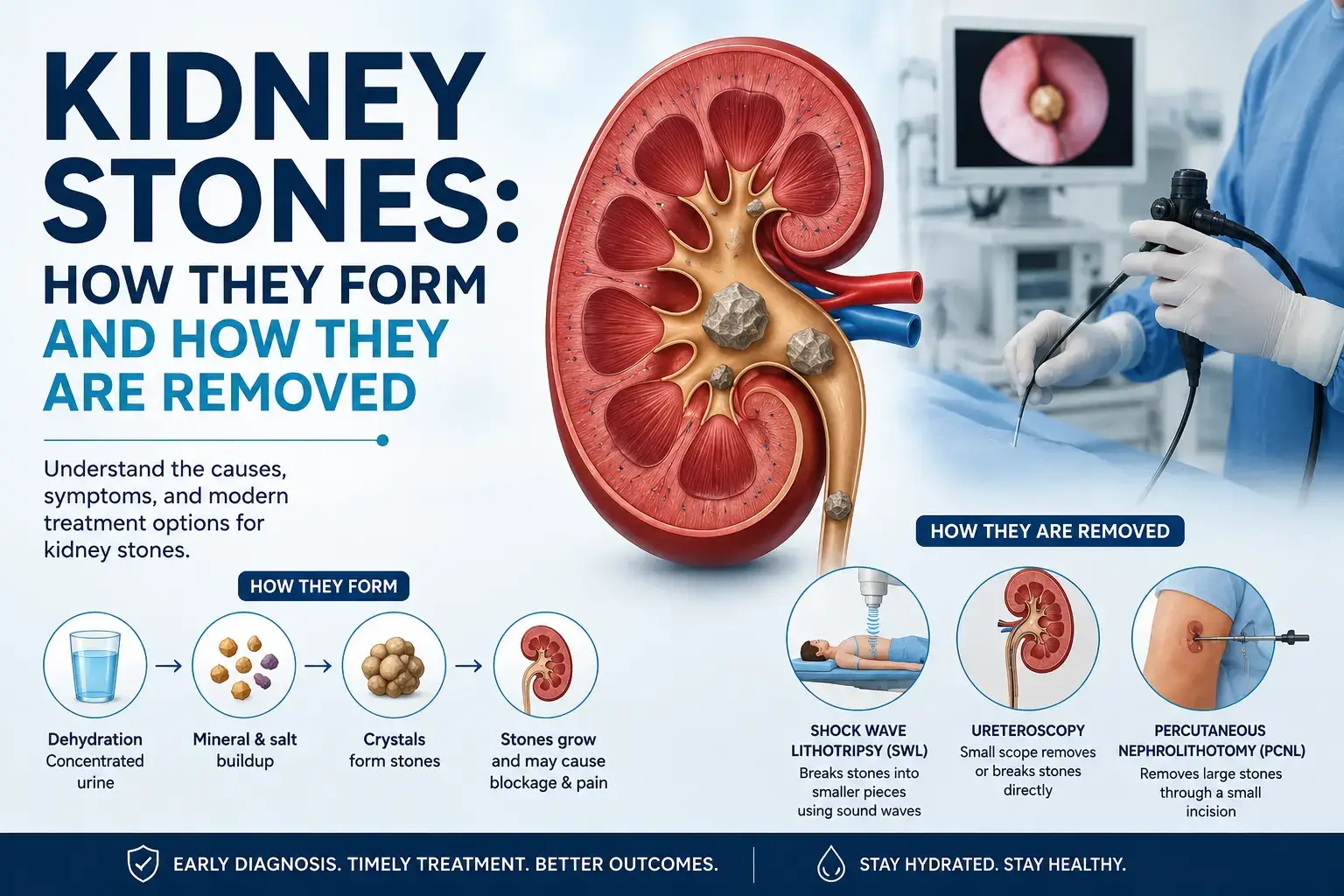
A kidney stone is a hard, solid mass that forms inside the kidney when certain minerals and salts in your urine become too concentrated and start to crystallise. Think of it like sugar or salt settling at the bottom of a glass when there’s too much dissolved in too little water except this happens inside your kidney, and the crystals can grow over days, weeks, or even months.
Stones can range in size from a tiny grain of sand to a pebble and in rare cases, even larger. Small stones often pass out of the body on their own through urine, sometimes without you even noticing. Larger stones, however, can get stuck in the urinary tract, causing intense pain and requiring medical treatment.
How Do Kidney Stones Form?
Your kidneys are constantly filtering your blood and producing urine, which carries waste products out of the body. Most of the time, these waste products stay dissolved in the urine and pass out harmlessly. But when the balance tips when there’s too much of certain minerals and not enough fluid to keep them dissolved crystals begin to form.
Several different types of stones can develop depending on what’s causing the imbalance:
Calcium Oxalate Stones — the most common type, accounting for roughly 80% of all kidney stones. They form when calcium and oxalate (a naturally occurring compound found in many foods) combine in the urine. Eating too much of certain foods, not drinking enough water, or having conditions that affect calcium absorption can all contribute.
Uric Acid Stones — form when urine is too acidic. They’re more common in people who eat a high-protein diet (lots of red meat, seafood, or organ meats), those with gout, or people who are dehydrated. Uric acid stones are more common in men than women.
Struvite Stones — these are linked to urinary tract infections (UTIs). The bacteria responsible for certain UTIs produce chemicals that make urine more alkaline, encouraging this type of stone to form. Struvite stones can grow quickly and become quite large.
Cystine Stones — a rarer type caused by a genetic condition that causes the kidneys to excrete too much of an amino acid called cystine. These tend to run in families.
Who Is at Risk?
Kidney stones don’t discriminate they can affect men, women, and even children. However, some factors make a person more likely to develop them:
- Not drinking enough water is the single biggest risk factor. Concentrated urine gives minerals more opportunity to crystallise.
- Diet — high intake of salt, protein, and oxalate-rich foods (like spinach, nuts, chocolate, and tea) can increase risk.
- Family history — if a parent or sibling has had kidney stones, your chances are higher.
- Previous kidney stones — once you’ve had one, the likelihood of getting another within 5–10 years is significant without preventive measures.
- Obesity — being overweight changes the acid levels in urine, increasing stone risk.
- Certain medical conditions — including gout, hyperparathyroidism, recurrent UTIs, and inflammatory bowel disease.
- Hot climate — living in a warm region like Maharashtra, where we sweat more and lose fluids faster, means we need to drink even more water to compensate.
- Certain medications — some drugs, including diuretics and calcium-based antacids taken in excess, can contribute to stone formation.
What Does It Feel Like?
Small stones may pass silently. But when a stone is large enough to block or irritate the urinary tract, the symptoms can be impossible to ignore:
- Severe, cramping pain in the side and back, just below the ribs — this is called renal colic and it comes in waves, often with no warning
- Pain that radiates downward toward the groin and lower abdomen as the stone moves
- Burning or pain while urinating
- Blood in the urine — urine may appear pink, red, or brown
- Nausea and vomiting, often triggered by the intensity of the pain
- Frequent urge to urinate, sometimes with only small amounts passing
- Fever and chills if an infection is present — this needs urgent medical attention
If you experience fever alongside stone symptoms, please seek care immediately. An infected, blocked kidney is a medical emergency.
How Are Kidney Stones Diagnosed?
When you come to Samata Hospital with symptoms suggestive of a kidney stone, our team will carry out a thorough evaluation:
- Urine test — to check for blood, crystals, and signs of infection
- Blood tests — to assess kidney function and levels of calcium, uric acid, and other minerals
- Imaging — an ultrasound is often the first step; a CT scan (KUB CT) gives a more detailed picture of the stone’s size and exact location
- Stone analysis — if you pass a stone, we may ask you to collect it for analysis to understand what type it is and guide future prevention
How Are Kidney Stones Treated?
Treatment depends on the size and location of the stone, the type of stone, and how much discomfort it’s causing. Here’s how modern medicine approaches it:
For Small Stones — Watch and Wait
Stones smaller than 5–6 mm often pass on their own within a few weeks. Your doctor may recommend:
- Drinking large amounts of water (2–3 litres a day) to help flush the stone through
- Pain relief medication to manage discomfort during the process
- Alpha-blockers — medications that relax the muscles in the ureter (the tube from the kidney to the bladder), making it easier for the stone to pass
- Regular follow-up imaging to track progress
ESWL — Shockwave Lithotripsy
For stones that are too large to pass on their own but not large enough to require surgery, shockwave lithotripsy is a popular non-invasive option. High-energy sound waves are directed at the stone from outside the body, breaking it into smaller fragments that can then pass naturally through urine.
It’s done as an outpatient procedure no cuts, no anaesthesia in most cases, and patients can usually go home the same day. Multiple sessions may sometimes be needed.
URS — Ureteroscopy
When a stone is lodged in the ureter or the lower part of the kidney, a ureteroscopy may be recommended. A thin, flexible camera (ureteroscope) is passed through the urethra and bladder and up into the ureter to reach the stone. Once located, the stone is either removed directly or broken up with a laser before being extracted.
This is a minimally invasive procedure done under anaesthesia, with most patients returning to normal activity within a day or two.
PCNL — Percutaneous Nephrolithotomy
For large stones (typically over 2 cm) or stones in complex positions, PCNL is the gold standard. A small incision is made in the back, and a thin tube is passed directly into the kidney. The stone is broken up and removed through this tube.
Though it sounds more involved than the other options, PCNL has a high success rate and is far less traumatic than traditional open surgery. Most patients are back on their feet within a few days.
Open Surgery
Open surgery for kidney stones is now rare, reserved only for very unusual cases where other methods are not possible. The vast majority of kidney stone patients today are treated without a single surgical cut.
Life After a Kidney Stone — Preventing the Next One
Having a kidney stone is a strong signal from your body that something in your diet or lifestyle needs adjusting. The recurrence rate is high but so is the potential for prevention.
Drink more water. This is the single most important step. Aim for urine that is pale yellow, not dark. In India’s heat, 3 litres a day may be necessary.
Reduce salt. A high-sodium diet increases calcium in the urine. Cut back on pickles, packaged snacks, and extra salt at the table.
Moderate animal protein. Excess red meat, chicken, and seafood raises uric acid and calcium levels in the urine.
Don’t avoid calcium-rich foods. Contrary to what many people believe, dietary calcium (from food) actually helps by binding to oxalate in the gut before it reaches the kidneys. The problem is with calcium supplements taken without food.
Limit oxalate-rich foods if advised. If you’ve had a calcium oxalate stone, your doctor may ask you to reduce spinach, nuts, chocolate, and strong teas not eliminate them, but moderate them.
Follow up regularly. Kidney stone formers benefit from periodic urine and blood tests to catch any imbalances early.
A Word from Samata Hospital
At Samata Hospital, our urology team is experienced in managing kidney stones of all types and sizes from guiding patients through their first stone to handling complex cases that require surgical intervention. We combine advanced diagnostic technology with personalised, compassionate care, ensuring that every patient understands their condition and their options.
You don’t have to face this alone and you certainly don’t have to wait until the pain is unbearable to seek help. Whether you’ve had a stone before, suspect you might have one now, or simply want to know if you’re at risk, our team is here for you.
To book a consultation with our urology specialists at Samata Hospital, reach out to us today. Because your kidneys work hard for you let us help you take care of them.
“Also Read: Gallbladder Pain? Here’s When You Should Visit a Specialist in Dombivli“
➝https://www.samatahospital.com/gallbladder-pain-heres-when-you-should-visit-a-specialist-in-dombivli/


No Comments
Sorry, the comment form is closed at this time.